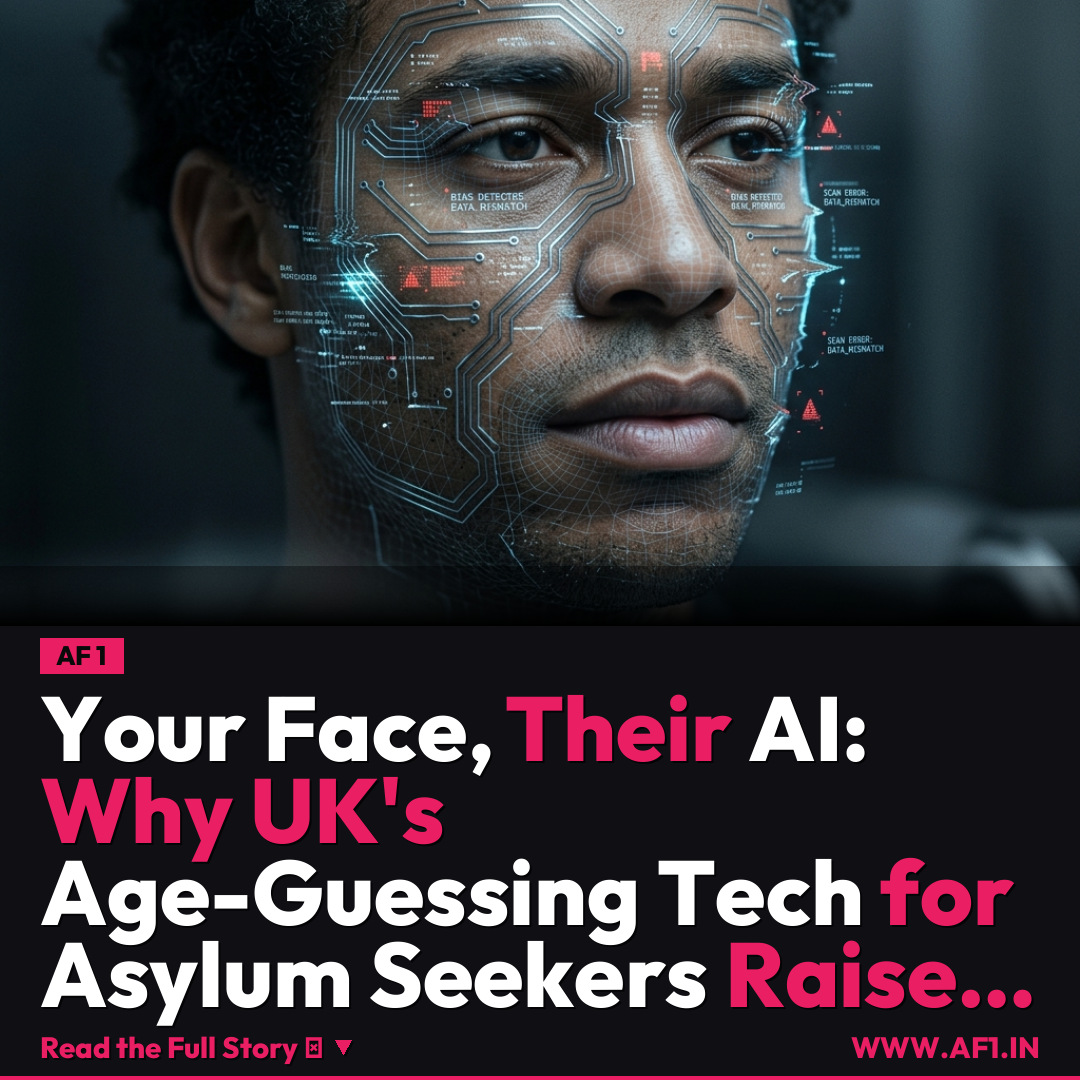
Your Face, Their AI: Why UK's Age-Guessing Tech for Asylum Seekers Raises Red Flags
Understand why the UK government's plan to use facial age estimation on asylum seekers is sparking alarm due to documented flaws and racial bias, affecting vulnerable individuals at the border.
Editorial Note
"Reviewed and analysis by AF1 Editorial Team."
In this article
Imagine your future being determined not by evidence, but by an algorithm guessing your age from a scan of your face. Now, imagine you're a child, fleeing trauma, arriving at a new border. This isn't a dystopian novel; it's the reality facing asylum seekers at the UK border, where the government plans to deploy facial age estimation technology despite a clear understanding of its significant flaws and potential for bias.
Key Details
You might think advanced technology offers a quick, objective solution, but an internal UK government report, uncovered by WIRED and Lighthouse Reports, tells a different story. This report highlights that the very facial age estimation technology the UK Home Office intends to use to determine the age of asylum seekers is known to be inaccurate. Specifically, the system, developed by Cognitec, performed significantly worse when estimating the ages of individuals from Sub-Saharan Africa compared to other demographics. For female Sub-Saharan Africans, the technology’s age guesses were off by an average of 4.6 years, a margin that could fundamentally alter a person's life trajectory, mistaking a child for an adult, or vice-versa.
This isn't a minor glitch; it's a critical flaw in a system intended for a profoundly sensitive application. Prominent voices are raising alarms about these plans. Martha Dark, co-executive director of the rights group Foxglove, unequivocally stated, "Children seeking asylum have often suffered unimaginable trauma. They should not be the test subjects for experimental tech that has baked-in inaccuracy and racist bias." This sentiment is echoed by Anna Bacciarelli, a senior researcher at Human Rights Watch, and emeritus professor Tim Cole of University College London’s Institute of Child Health, who has also voiced concerns about the technology's reliability. The Independent’s Holly Bancroft has reported extensively on these issues, drawing attention to the broader implications of deploying such unproven systems.
The National Institute of Standards and Technology (NIST) has long cautioned about the varying performance of facial recognition systems across different demographic groups, a concern that clearly manifests in the UK's proposed use of this technology. The UK government's move comes despite these warnings and its own internal assessments revealing the technology's shortcomings, especially when applied to diverse populations, as would be the case for individuals arriving from various regions seeking asylum in the United Kingdom via routes like the English Channel or from countries like Germany.
Why This Matters
You might be wondering why a few years off in an age estimate matters so much. For asylum seekers, especially children, an incorrect age determination can have catastrophic consequences. If a child is wrongly identified as an adult, they could be placed in adult detention centers, denied access to specific protections and support tailored for minors, and face different legal processes that are not equipped to handle the vulnerabilities of a child. Conversely, an adult wrongly identified as a child could also face inappropriate care or be viewed with suspicion, hindering their asylum claim.
This situation underscores a critical ethical dilemma: should governments deploy technology known to have "baked-in inaccuracy and racist bias" in such a high-stakes humanitarian context? The data showing worse performance for Sub-Saharan Africans isn't just a technical footnote; it points to a systemic issue where technological solutions can inadvertently perpetuate and amplify existing societal biases, disproportionately affecting vulnerable groups. Your understanding of this issue is vital because it highlights the broader challenges of integrating AI into public services, particularly when human rights are on the line. The trust in government processes, and indeed, the very fairness of the system, hinges on the accuracy and impartiality of the tools it chooses to employ.
The Bottom Line
As you navigate a world increasingly influenced by AI, the UK government’s plan to use flawed facial age estimation on asylum seekers serves as a stark reminder. This isn’t just about efficient border control; it’s about the fundamental principles of fairness, accuracy, and human dignity. Before embracing new technologies for sensitive applications, you should demand transparency and rigorous independent testing, especially when the tech has known biases and directly impacts vulnerable populations. The integrity of our systems, and the protection of those most in need, depends on our collective vigilance in questioning whether a technological solution, no matter how appealing, truly serves justice for everyone it touches.
Originally reported by
WiredWhat did you think?



Stay Updated
Get the latest tech news delivered to your reader.