How a 1976 UMass Experiment Quietly Revolutionized Your Energy Future
Discover how a scrappy 1976 University of Massachusetts Amherst experiment on Orchard Hill secretly launched the US wind power industry, shaping your renewable energy landscape today.
Editorial Note
"Reviewed and analysis by AF1 Editorial Team."
In this article
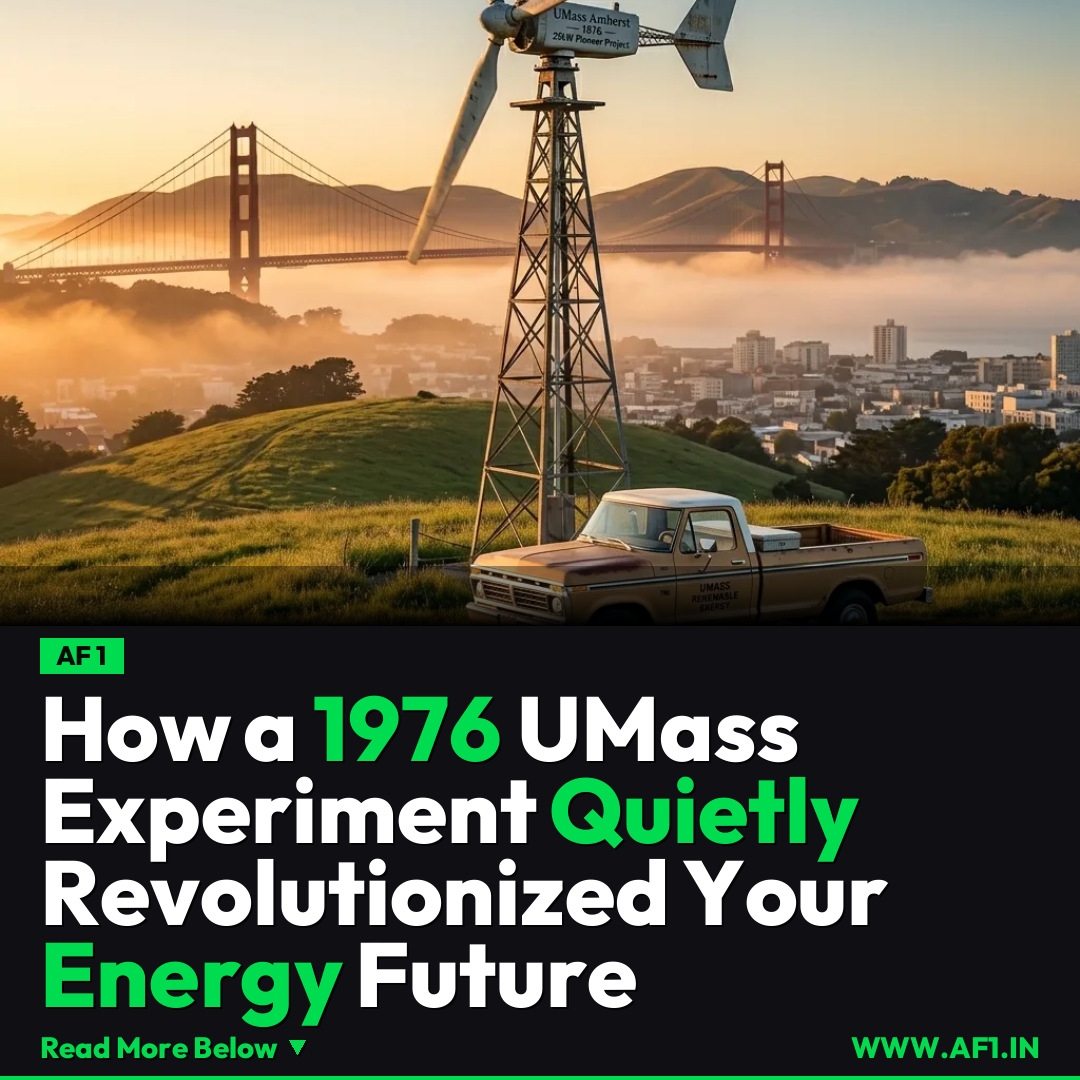
You might take modern wind farms for granted, but their very existence in the United States traces back to a surprising origin: a scrappy crew at the University of Massachusetts Amherst. A half century ago, this team erected a wind turbine on Orchard Hill, the highest point on campus. You probably didn't know this seemingly small project, with its 25-kilowatt output and 4.5-meter blades, would quietly ignite the American wind industry, shaping the very energy grid you rely on today.
Key Details
Imagine, it's 1976. The energy landscape is shifting, and you've got a brilliant but controversial mind like Captain William Heronemus, alongside engineers Michael Edds, Sandy Butterfield, Louis Manfredi, Jim Sexton, Fred Antoon, Brian Kuhn, and even freshman Dan Handman, all working tirelessly. Professors Duane Cromack and Jon McGowan, along with doctoral students Forrest "Woody" Stoddard and Ted Van Dusen, were also integral to this pioneering spirit. Their mission? To build and test what they called a "Wind Furnace" right there on Orchard Hill at UMass Amherst.
This wasn't just an academic exercise; it was a hands-on endeavor to prove wind's potential. The turbine, with its modest 25-kilowatt capacity and 4.5-meter blades, generated so much heat that, as one person famously quoted in Peter Asmus’s book Reaping the Wind, "We had to open up the doors in the dead of winter. It was just too damn hot." Even future White House Science Advisor John Holdren was among those who witnessed its early success. The project showed incredible promise, not just for power generation but for direct thermal use.
The UMass Amherst Wind Turbine quickly became a magnet for attention. You might be surprised to learn it secured funding from heavy hitters like NASA and the National Science Foundation, drawing the gaze of major players. Organizations such as the National Renewable Energy Laboratory (NREL) and the Electric Power Research Institute (EPRI) were influenced by its groundbreaking work. Even corporations like Boeing, Grumman Aerospace, US Windpower, and Goldman-Sachs were watching this small New England experiment, eventually planting roots for large-scale wind projects in locations like the Great Plains, California's Altamont Pass, and Burlington, Massachusetts. Robert Thresher, Director of Wind Research at NREL, even acknowledged its foundational impact.
You see, William Heronemus wasn't just a builder; he was a fierce advocate for wind power. His passionate, and at times controversial, criticism of nuclear power, coupled with his tireless promotion of wind, helped shift the national conversation and secure the necessary backing for this burgeoning industry.
Why This Matters
So why should you care about a 50-year-old experiment on a university campus? Because this single topic, deep coverage shows how foundational, grassroots innovation directly impacts your life today. The power flowing to your devices, the increasing presence of renewable energy in your grid mix, and the very concept of large-scale wind power in the U.S. all have roots in that UMass Amherst project. It demonstrates how visionary thinking, even when considered controversial at the time, can lay the groundwork for a cleaner, more sustainable energy future for you and your community.
This story reminds you that the biggest changes often start small. It highlights the critical role of university research and dedicated individuals like those at UMass Amherst in pioneering technologies. When you see a modern wind turbine, remember the scrappy team who, with a Ford Truck and an idea, proved that harnessing the wind was not just a pipe dream but a tangible, powerful solution that would eventually scale up to power homes and businesses across the nation.
The Bottom Line
What should you do with this information? Recognize the deep history behind your modern technology. Understand that supporting fundamental research, especially at universities, can have unforeseen, massive payoffs that shape your future. The next time you consider energy solutions, remember the UMass Amherst "Wind Furnace" and appreciate that long-term vision and persistent innovation are key to solving global challenges and powering your world. You have a stake in knowing where your energy comes from and the journey it took to get there.
Originally reported by
IEEE SPECTRUMWhat did you think?



Stay Updated
Get the latest tech news delivered to your reader.